
A pool fence needs to do more than complement your yard. It must form a reliable barrier, work with the rest of the property, and satisfy the requirements that apply where you live. If you are researching pool fence requirements in Pennsylvania, start with the current state code and then confirm the details with your local code office before choosing a design.
This Pennsylvania residential swimming-pool provision says that a pool, hot tub, or spa accessory to a one- or two-family dwelling must comply with the 2021 International Swimming Pool and Spa Code. Your municipality can tell you how that standard applies to your property, which permits and inspections are required, and whether local ordinances add other conditions.
A professional fence installation plan should bring those requirements together with your pool layout, grade, access needs, and preferred material.
Start With the Rule That Applies to Your Pool
Do not begin by copying a neighbor’s fence or relying on a generic online checklist. The correct requirements can depend on the type of pool or spa, the property, the barrier design, and the authority that reviews the work.
Before requesting proposals, contact the municipal code office for the property and ask:
- Which swimming-pool and barrier standard applies to this project?
- Is a permit required for the pool barrier, the fence, or both?
- Which drawings, measurements, or product details must be submitted?
- Will the gate and barrier be inspected before the pool can be used?
- Do local zoning rules affect fence placement or height?
- Are there separate requirements for an above-ground pool, in-ground pool, hot tub, or spa?
This step protects you from designing around the wrong assumptions. It also gives the installer a clearer target for the layout and gate hardware.
Pool safety should use multiple layers rather than depend on one feature. The U.S. Consumer Product Safety Commission’s Pool Safely safety guidance recommends barriers, covers, and alarms as safety devices, along with active supervision and other precautions. A fence is an important layer, but it does not replace attentive adult supervision.
What to Check Before Choosing a Pool Fence
A code-conscious plan starts with the full barrier path, not just the most visible fence panel. Walk the proposed route and look for places where the yard, house, structures, or landscaping could weaken the enclosure.
Barrier continuity
The barrier should create a continuous controlled boundary around the pool area. Ask the local official and installer how the house, deck, retaining wall, existing fence, or other structure affects that boundary. A design that looks closed from one angle can still have a weak transition at a corner, grade change, or connection point.
Openings and climbable conditions
Discuss the spacing between pickets, below the fence, and at transitions. Also look for nearby objects that could make the barrier easier to climb, such as furniture, planters, equipment, low branches, or horizontal features. The applicable code and the selected fence system should determine the final details.
Distance from the water and equipment
The fence line needs enough room for safe movement, gate operation, maintenance access, and any required clearances. Tight layouts around pool equipment, narrow side yards, or sloping ground deserve particular attention before materials are ordered.
Review Garrido Fences’ current fence types only after you understand these site constraints. The best-looking option is not useful if it cannot form an appropriate barrier on the actual property.
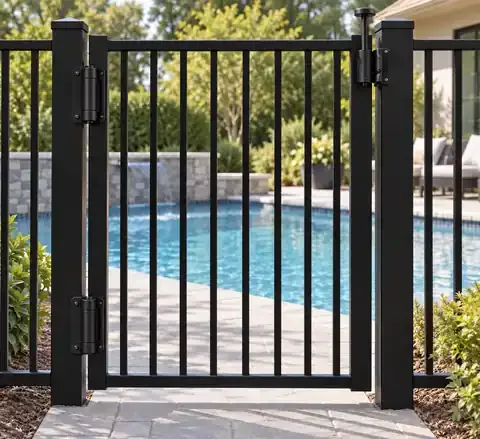
Give the Gate Extra Attention
The gate is a moving part in an otherwise fixed barrier, so it deserves a separate review. Ask your code official and installer to confirm the required direction of swing, closing action, latch operation, latch position, opening size, and clear space around the gate.
A pool gate should be evaluated in real conditions, not only on a product sheet. Grade changes can interfere with the swing. A gate that is too narrow may not support normal maintenance access. A gate that is much wider than needed may require different hardware or a different layout. Posts also need to remain aligned so the gate can close and latch consistently.
During planning, check:
- Where people will approach the gate from the house and yard
- Whether the gate can swing freely across the finished surface
- How the latch will be reached and operated
- Whether landscaping or furniture could obstruct the gate
- What access is needed for pool service or yard equipment
- How the gate will be tested and maintained after installation
Do not treat a self-closing or self-latching label as proof that the installed gate will perform correctly. The complete assembly, including the post alignment, hinges, latch, clearances, and finished grade, needs to work together.
Match the Fence Material to the Site
Material choice affects appearance, privacy, visibility, maintenance, and how the barrier follows the yard. Compare those priorities only within the options that can satisfy the approved layout.
Aluminum fencing can provide an open view of the pool area. PVC and vinyl fencing may suit homeowners who want more visual separation in parts of the yard. Garrido Fences also has a current page for wrought iron fencing, but the exact product and its suitability for a pool barrier should be confirmed during the estimate.
Avoid choosing solely from a photo. The installer needs to account for slopes, corners, grade gaps, gates, nearby structures, drainage, and the approved barrier path. A site visit can reveal conflicts that are not visible on a survey or online map.
Confirm Permits, Property Limits, and Utilities
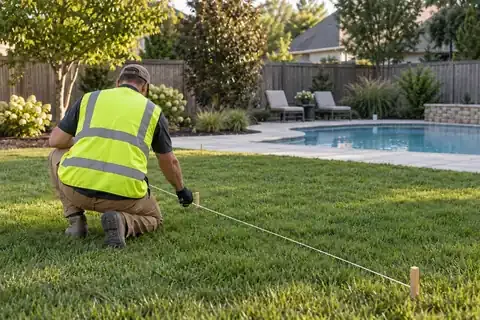
Code review is only one part of pre-installation planning. Confirm the property boundary, recorded easements, and any homeowner-association requirements that apply. Do not assume an existing fence marks the legal lot line or that an old layout is still acceptable.
Fence posts also require excavation. 811 Before You Dig says anyone planning to install a fence must contact 811 or the state 811 center before digging, wait the required time, and confirm that utilities have responded. Utility marks do not establish property lines, and property records do not identify every underground utility. Both checks have separate purposes.
A Practical Pre-Installation Checklist
Use this list to organize questions before the site visit:
- Identify the municipality with jurisdiction over the property.
- Ask which pool-barrier code and local ordinances apply.
- Confirm permit, drawing, and inspection requirements.
- Locate the property line and review recorded easements.
- Check any homeowner-association restrictions.
- Map the entire barrier route, including connections to structures.
- Identify slopes, drainage paths, landscaping, equipment, and access needs.
- Confirm the gate swing, latch plan, opening, and finished grade.
- Compare materials that can work with the approved design.
- Contact 811 and follow the ticket instructions before excavation.
- Keep pool furniture and other climbable objects away from the barrier.
- Plan regular gate and barrier checks after installation.
You can review Garrido Fences’ current service area and use the online fence cost calculator for early planning. A calculator cannot account for every pool-barrier requirement or property condition, so the final scope should come from a site-specific review.
Plan the Pool Barrier Around the Whole Property
A strong pool-fence plan connects code requirements, safety, gate operation, material choice, access, and the realities of your yard. Confirm the rules first, then use an on-site assessment to resolve the details before installation begins.
If your property is in Garrido Fences’ service area, request a free estimate to discuss the fence route, gate access, material options, and site conditions. Municipal approval and code interpretation remain with the appropriate local authority.