
Most wood privacy fence boards are not perfectly flat for their entire life. Boards cup, twist slightly, or shrink as they dry, and any single row of flat boards set edge to edge will eventually show a narrow gap somewhere along the line, similar to the kind of split that opens between two boards as wood ages and moves. Shadowbox and board-on-board are two different approaches to the same underlying problem: how to build a wood privacy fence that handles those gaps well rather than fighting them.
The Problem Both Styles Are Solving
A basic flat-board privacy fence, sometimes called a stockade fence, sets boards edge to edge in a single row on one side of the rails. When boards are brand new and perfectly milled, the fit can look solid. Over time, as boards dry and move, small gaps can open between them, letting slivers of light and visibility through a fence that was built to block both. Shadowbox and board-on-board fencing are both designed around this reality rather than around it.
Shadowbox Fencing
A shadowbox fence alternates boards on opposite sides of the rails, with boards on the front overlapping the gaps between boards on the back. From directly in front, the fence reads as a single flat privacy surface. At an angle, you can usually see a narrow sliver through the overlap, and the structure gives the fence a slight shadow-line texture that gives the style its name.
Advantages:
- Identical appearance from both sides. Because boards alternate front and back, neither side of the fence looks like the "ugly side" with exposed rails and posts, which is part of why shadowbox is a common choice along a shared property line.
- Better airflow. The narrow overlap gaps let some air move through the fence line, which can reduce the wind load the fence structure has to resist during a storm compared to a fully solid panel.
- Visual interest. The alternating board pattern creates a subtle depth and shadow line that a flat board-on-board fence does not have.
Tradeoffs:
- Less than fully solid privacy. The overlap gaps mean there is some visibility through the fence at an angle, even though it reads as solid when viewed straight on.
- More boards and more hardware than a single-row fence, since both sides of the rail are covered.
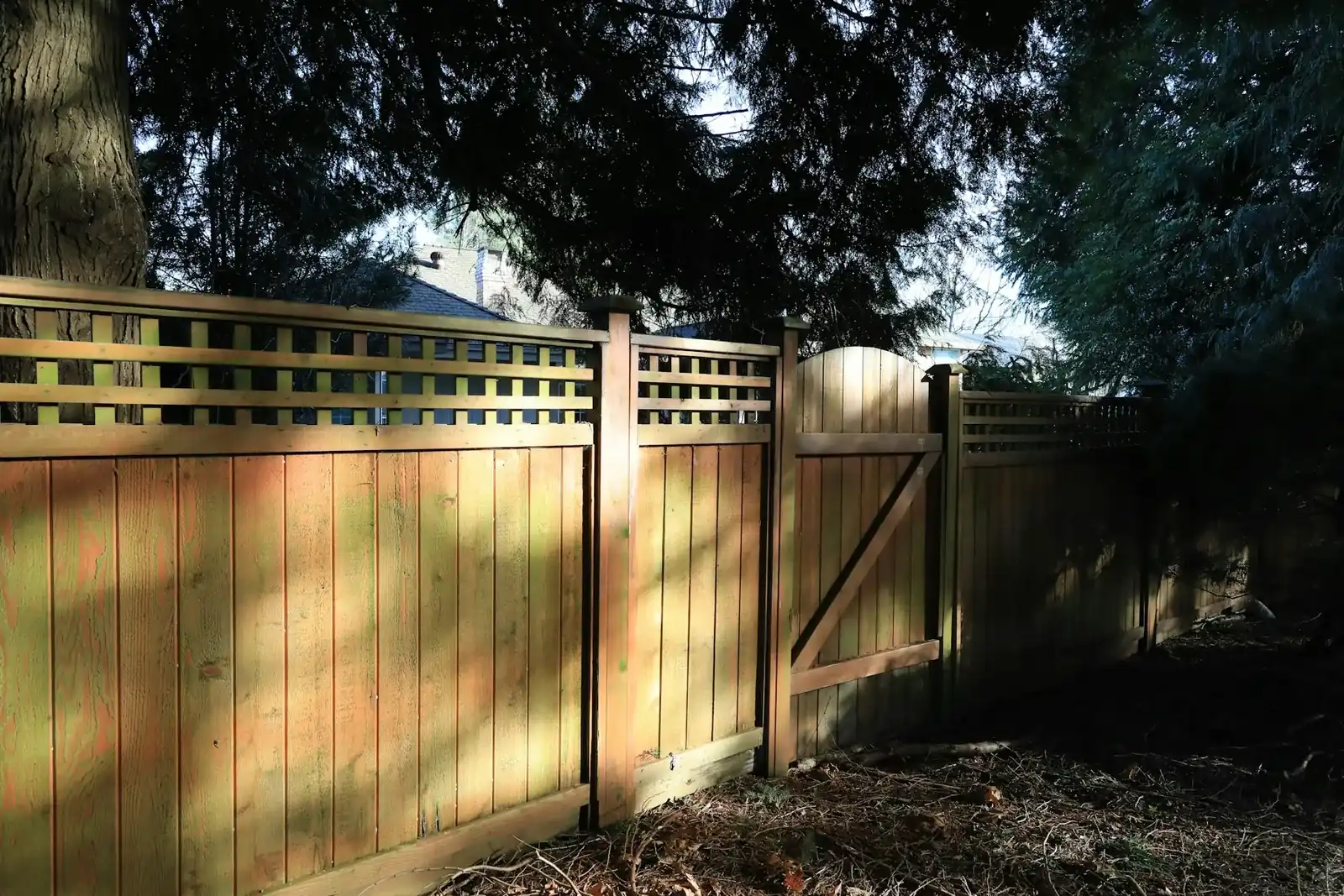
Board-on-Board Fencing
Board-on-board fencing also uses two staggered rows of boards, but both rows sit on the same side of the rails rather than alternating front and back. The second row of boards overlaps the gaps in the first row by enough to close off any sightline, so the fence has a completely solid look from the side with the double layer, while the opposite side shows the rails and the backs of the boards, the same way a single-row privacy fence does.
Advantages:
- Fully solid privacy with no sightline gaps, even after boards shrink or move over time, since the overlap is generous enough to absorb typical board movement.
- A more substantial, dimensional look from the finished side, which some homeowners prefer visually over the flatter shadowbox pattern.
Tradeoffs:
- One side shows the structural framework. Unlike shadowbox, board-on-board has a clear finished side and a clear back side, so placement matters along a shared boundary if both neighbors care about which side they see. A "good neighbor" layout, discussed in our HOA fence rules guide, is one way some communities address this.
- More material. Because both rows sit on the same side rather than alternating, board-on-board typically uses more boards per linear foot than shadowbox for the same finished height.
- Less airflow than shadowbox, since there is no intentional gap for air to pass through once the second row closes the sightlines.
Material Considerations for Either Style
Both styles are typically built with wood, and the choice of species and treatment matters as much as the pattern itself. Penn State Extension's guidance on wood fence posts, while written for horse fencing, applies to privacy fence posts as well: a pressure-treated post from a reputable dealer can last roughly ten to twenty-five years depending on soil conditions and treatment quality, compared to a shorter life for an untreated post, and round posts accept more uniform pressure treatment than square posts of a similar size. Whichever board pattern you choose, the posts and framework underneath are what the whole structure depends on long term.
If pressure-treated lumber is part of your fence, it is worth knowing that today's residential pressure-treated wood uses different preservative formulations than the chromated arsenical treatments that were in common use decades ago. The EPA's background on chromated arsenicals notes that manufacturers voluntarily stopped producing that older treatment for homeowner use in December 2003, so it is not something you need to weigh when choosing new lumber today, though it is useful background if you are working around an older structure built before that change.
Before any post holes are dug for a new fence, remember that PA One Call requires a call to mark utility lines first, regardless of which board pattern you choose.
Maintenance Differences Between the Two Styles
Routine maintenance, inspecting for loose boards, checking posts and gates, and cleaning or treating the wood, applies to both styles in similar ways, but a few details differ:
- Board-on-board has more total boards per linear foot, which means more fasteners and more individual pieces to inspect over time, even though neither style is inherently less durable than the other.
- Shadowbox's gaps are part of the design, so a small gap you notice is not necessarily a sign of movement or damage the way a new gap in a board-on-board fence, where boards are meant to overlap fully, might be worth a closer look.
- Both styles benefit from the same seasonal routine: checking gates and hardware, clearing vegetation and debris from the base of the fence, and watching for soil movement around posts after heavy rain or winter freeze-thaw cycles.
Height and Local Code Considerations
Both shadowbox and board-on-board fences are typically built to the same heights as any other wood privacy fence, so the same local rules apply regardless of which board pattern you choose. Fence height limits are set township by township rather than at the state or county level; see our guide to privacy fence height limits in Bucks and Montgomery County for how to find the specific number that applies to your property before finalizing a design in either style.
Which Style Fits Your Yard
Shadowbox tends to make the most sense along a shared property line where both neighbors want a similar, finished-looking view, or in a windier spot where some airflow through the fence is an advantage. Board-on-board tends to make more sense when fully solid privacy from one specific side matters more than airflow or a shared appearance, such as a backyard where you want to eliminate any sightline toward a neighbor or a street.
Both styles can be built from the same wood species and at the same heights, so the decision mostly comes down to how much you value airflow and a shared appearance versus a completely solid sightline from one side.
Comparing Wood Privacy Styles for Your Property
Garrido Fences builds both shadowbox and board-on-board wood privacy fencing as part of its wood fencing options, across its service area in Bucks, Montgomery, and Lehigh County. If you are still deciding between wood and another material entirely, our wood vs. vinyl vs. metal fencing comparison covers the broader material decision before you get into board pattern specifics.
Request a Wood Privacy Fence Estimate
Whether you are leaning toward shadowbox, board-on-board, or still weighing the difference, contact Garrido Fences to request a free estimate and see samples of both styles for your property.